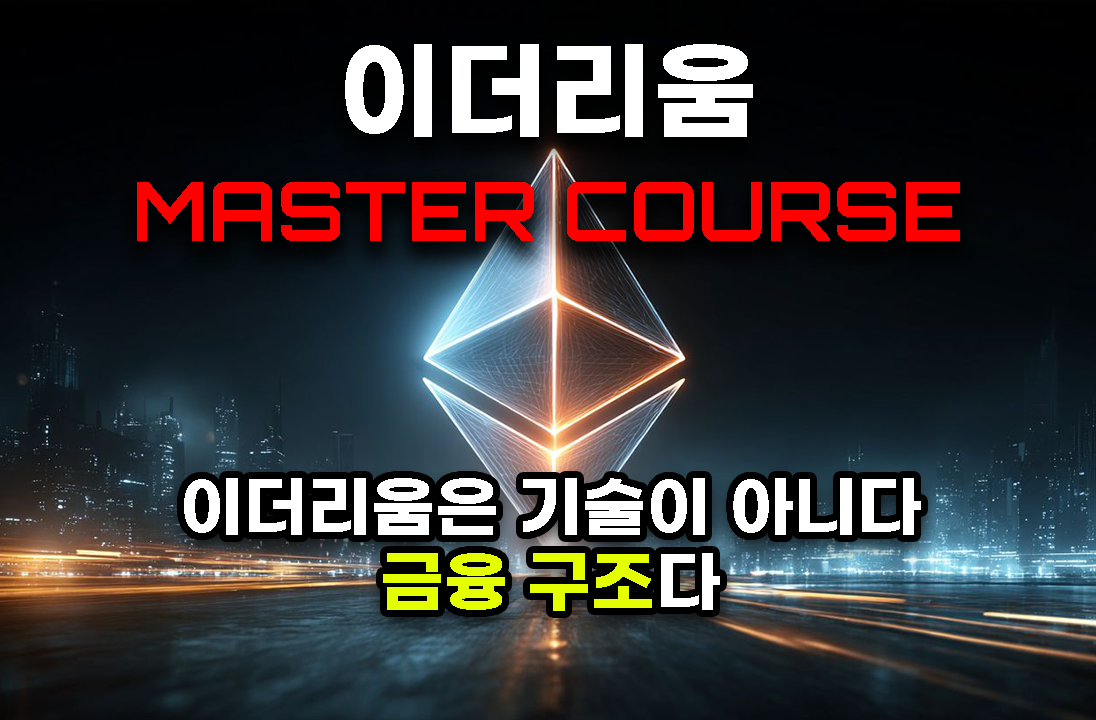
Ethereum Core Architecture Masterclass
A full-stack Web3 master course designed to help you understand the entire Ethereum ecosystem as a whole.
About the Instructor

코인크래프트
Course Overview
Recommended for These People
1) Who Must Take This Course
- Beginners in Web3 development who want to quickly build practical skills
- Those who want to create their own tokens, NFTs, and smart contracts from scratch
- Those who want to understand Ethereum's internal architecture to build onchain data analysis capabilities
- Developers, product managers, and creators who want to truly understand the essence of Web3
2) Those Who Already Know Web3 but Want to Learn Deeper
- Those who understand mechanisms but don't know actual code flow
- Those who have done crypto investing or onchain analysis and wondered "how do contracts actually work?"
- Those who know Solidity basics but wanted to clearly understand EVM, gas, and memory structure
3) Various Professionals Looking to Expand Their Careers
- Developers → upgrade your position to Web3 developer
- Data analysts → expand into onchain analysis
- Consultants/product managers → differentiate yourself as a "blockchain practical knowledge" expert
- YouTubers/bloggers → build a strong foundation for Web3 expert content creation
After This Course, Here's How You'll Change
- You'll understand and practice the Solidity language from start to finish.
- Rather than simple exercises, you'll build complete DApp projects from scratch.
- You'll deploy actual smart contracts on Sepolia/Holesky testnets.
- You'll connect frontend and backend using Web3.js / Ethers.js.
- You'll understand EVM's internal architecture and gas cost models.
- You'll gain the ability to read contract events in onchain analysis.
- Core principles of DeFi, NFTs, and token economics will become tangible to you.
- You'll create 3 complete projects you can add to your portfolio.
Course Features
1) Not a "Copy-Along" Course – Understanding-Based, Practical-Focused
This isn't just showing code;
it's designed to help you understand why code is written this way / what would happen differently / what's happening internally
through principles, one step at a time.
2) A Practical Reinterpretation of "Mastering Ethereum"
This course isn't just an introductory class—it includes
a practical reinterpretation of "Mastering Ethereum," written by Ethereum's creator Gavin Wood.
3) Beginner-Friendly Accessibility + Depth for Intermediate Learners
Structured step-by-step with no jumps so Web3 beginners can follow along,
but covers EVM, gas, and memory architecture so intermediate learners definitely gain value.
4) 3 Real-World DApp Projects Included
- Token Creation and Deployment Project (ERC-20)
- NFT Minting Project (ERC-721)
- Auction DApp: React Frontend + Smart Contract Integration
5) Completely Refactored Based on Latest 2025 Standards
All source code is updated to the latest version as of 2025,
using latest tools like Truffle, Remix IDE, and MetaMask.
What You'll Learn
Lecture 1. What is Ethereum?
- Philosophy and purpose of blockchain
- Structural differences between Bitcoin and Ethereum
- The era of smart contracts
- Understanding Web3's "trust-minimized architecture"
- Why Ethereum became the standard for Web3
Lecture 2. Ethereum Fundamentals
- Account structure: EOA vs Contract
- Relationship between state, blocks, and transactions
- Storage/Memory/Calldata
- Ethereum network structure (mainnet, testnet, nodes)
- Preparing Ethereum development on Windows
Lecture 3. Ethereum Clients
- Role of clients like geth, Nethermind
- P2P networks, consensus, block synchronization
- Light Client vs Full Node
- Why developers must understand "clients"
Lecture 4. Cryptography
- Blockchain's foundational mathematics
- Hash functions (SHA-3), public/private key structure
- Signatures, key generation, transaction verification principles
- How cryptography becomes the pillar of Ethereum security
Lecture 5. Wallets
- Types of wallets: software / hardware / HD Wallet
- MetaMask installation and practical use on Windows
- Mnemonic structure and account derivation principles
- Everything that happens in a wallet (signatures, nonce, gas, etc.)
Lecture 6. Transactions
- Complete transaction structure breakdown
- nonce, gasLimit, gasPrice, fee calculation
- Understanding internal transactions and event logs
- Hands-on practice sending actual transactions in Remix
Lecture 7. Smart Contracts and Solidity
- Complete Solidity fundamentals
- Variables, functions, structs, mappings, events
- Writing your first Solidity code in Remix
- Compilation and deployment in Windows + Truffle environment
- Complete understanding of ABI structure
Lecture 8. Smart Contracts and Vyper
- Vyper language characteristics and philosophy
- Python developer-friendly Web3 language
- Comparing same functionality: Solidity vs Vyper
- When should you use Vyper?
Lecture 9. Smart Contract Security
- Reentrancy attack principles
- Overflow and access control issues
- Dangers of tx.origin usage
- Safe coding practices based on real hacking cases
- Security checks through Remix + Truffle testing
Lecture 10. Tokens
- ERC-20 token standard understanding
- Transfer, Approval, Allowance
- Creating your own ERC-20 token
- Sepolia testnet deployment practice
- Writing Truffle deployment scripts for Windows
Lecture 11. Oracles
- How blockchain retrieves external world data
- Chainlink basics
- Understanding Price Feed, VRF, Keeper
- Oracle security risks
- Hands-on: Integrating Chainlink Price Feed in Remix
Lecture 12. DApps
- DApp architecture: UI → Wallet → Contract
- Web3.js vs Ethers.js
- Setting up React environment on Windows
- Creating MetaMask-integrated UI
- Hands-on: Connecting smart contracts with React
Lecture 13. EVM (Ethereum Virtual Machine)
- Complete breakdown of EVM execution model
- Opcode, gas usage structure
- SLOAD/SSTORE cost analysis
- Practical review of Mastering Ethereum's core chapters
- Gas optimization techniques
Lecture 14. Consensus Protocols
- PoW → PoS transition background
- Validator structure and slashing mechanisms
- L1 / L2 scalability structure comparison
- From block creation flow to finality
- Consensus knowledge needed for Web3 developers
"This course isn't just a technical lecture—
it's created with the goal of providing Korea's most practical Ethereum learning experience."
❓ Do You Have Questions?
Q1. Can I follow along if I'm a complete beginner?
A. Yes. It's designed for Web3 beginners, and hands-on practice is guided step-by-step in a friendly manner.
Q2. Can I understand it if I'm not a developer?
A. Yes. Since the focus is on explanation, you can follow along if you understand the logic.
Q3. Environment setup is difficult—will you provide support?
A. All environment setup processes are provided as videos, with explanations covering every point where errors might occur.
Things to Note Before Taking the Course
Development Tools
- Node.js (LTS version)
- VS Code
- Remix IDE (web-based)
- Truffle Suite
- MetaMask (Windows browser)
- Sepolia/Holesky testnet
Why Windows?
- Most domestic developers and beginners use Windows
- All hands-on practice possible without virtual machines
- Truffle and Remix both work the same way on Windows
- Linux/Mac users can follow along with this universal setup
Learning Materials
- Source code provided via GitHub
- PDF summary notes provided
🔥 Now You Have One Mission
This course is the fastest and most reliable path to becoming a Web3 developer.
Start now.
Curriculum
수강생 리뷰